
elvex Launches New Enterprise AI Platform Built to Solve What Claude and ChatGPT Ignore

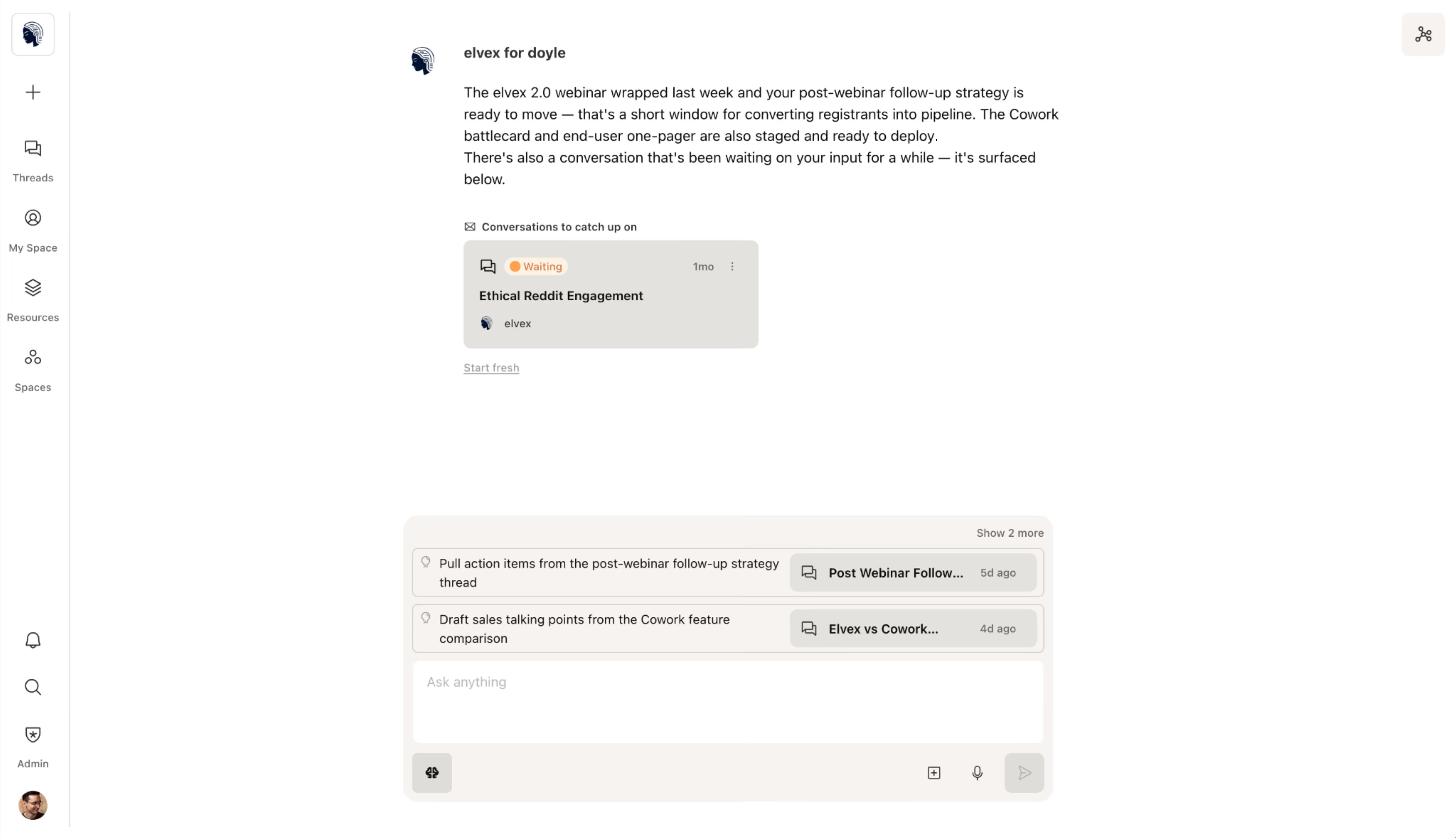
When you log in, elvex suggests new ways to use AI that fit the work you’re doing.
A system that comes to the user with ideas, built to remove the mental effort of the “blank chat box” and change how the whole organization works
SAN FRANCISCO, CA, April 22, 2026: elvex, the enterprise AI agent platform, today announced elvex 2.0, a new system architecture built to fix the biggest limit on AI use right now: the blank chat box.
The leading AI platforms, including those from Microsoft, OpenAI and Anthropic, are built mostly around the blank chat box, an interface where the user has to start and steer every interaction. Technical users do fine with it. Most of the rest of the company doesn’t. According to elvex, the models are capable enough. What’s missing is relief from the mental effort. Today’s systems expect users to know what to ask, how to ask it and what to do with the answer, and that effort falls on each person, every time.
So it’s no surprise that use inside companies has mostly stalled at the 10–15% of employees that are developers and other technical employees. What suits technology teams doesn’t suit everyone else. Many companies report that AI tools are widely adopted, but most employees use them only now and then and keep working much as they did before.
elvex’s view is that the models aren’t the problem. The way the systems are designed is.
“Enterprise AI today is individualistic and reactive, not collaborative and proactive,” said Sachin Kamdar, founder and CEO of elvex. “We’ve built extraordinarily powerful systems that assume the user knows what to ask, when to ask it, and how to interpret the output. That works for a small group of technical users. It breaks everywhere else.”
Many organizations have adopted AI on paper, and elvex argues that adoption by itself is a misleading measure. “Adoption is not the issue here. Company-wide transformation is,” Kamdar said. “The question isn’t whether employees have access to AI but whether their day-to-day work actually changes as a result.”
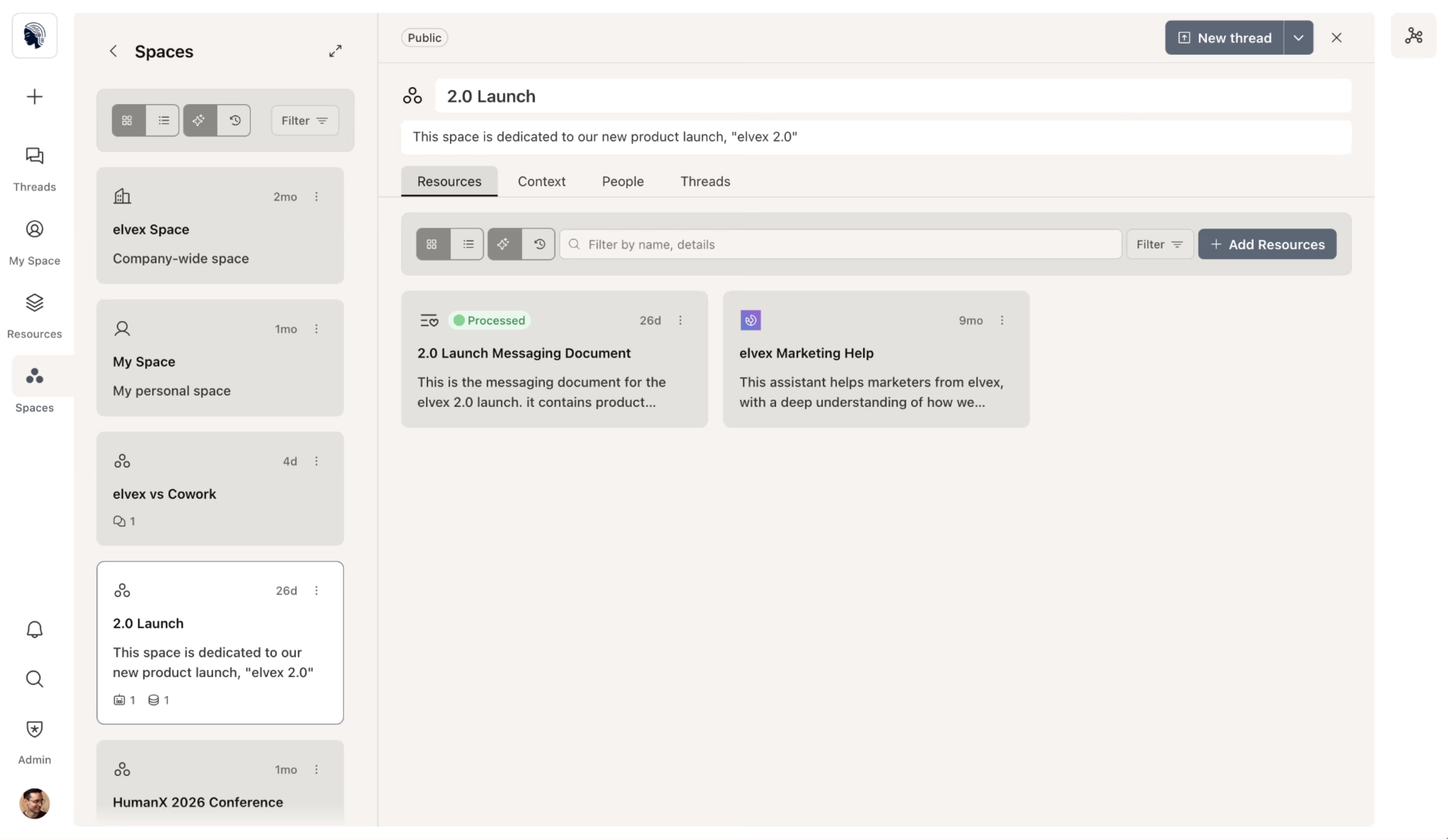
Most AI is built for one person at a time: you make a good workflow and then struggle to share it. Spaces in elvex fix that. They’re shared workspaces where teams work with AI agents together.
elvex 2.0 introduces a fundamentally different architecture.
The platform organizes work around shared, lasting workspaces called “Spaces,” where employees, AI agents and company data all work from the same context, which keeps updating as work happens. elvex doesn’t wait for users to start every interaction. It suggests prompts, workflows and recommendations, and coordinates work across systems in the background.
The change is in the structure itself. elvex replaces a blank chat box, where the user drives everything, with a system that knows your work and what AI can currently do, and connects the two.
Because elvex keeps coming to users with more advanced ways to use AI in their work, people don’t have to put in as much effort to get “good at using AI.” That makes it possible to move past occasional, shallow use to real change across the organization.
In early enterprise deployments, elvex reports significantly deeper and more sustained engagement relative to industry benchmarks. Customers including Movable Ink, Hallmark Health Care, and The Boston Globe have shown wide use inside their companies, along with measurable changes in how teams build AI into daily work.
In one deployment, a company rolled elvex out to everyone within eight weeks, after Microsoft Copilot never spread beyond a small group of users. In another, a customer cut AI-related costs by 50% while overall use went up, because the system guided people to more efficient ways of working.
“What’s breaking right now isn’t demand for AI whatsoever. The demand is there. What breaks is the interface between the technology and the organization,” said Ken Romano, SVP of Product at Stacker. “elvex changes that interface. It makes AI usable at the level where work actually happens.”
The launch comes at an important moment for enterprise AI. Vendors keep improving their models and adding AI to existing software, but many organizations are struggling to turn that into lasting change in how every employee works.
elvex’s position is simple: an AI platform should take the initiative, and it should work with any model, any integration and any employee, under the governance and security controls that let companies move faster with AI.
“The first phase of AI proved the capability of the models,” Kamdar said. “The next phase will determine whether they can actually be used: reliably, repeatably, and at scale. The companies that win will be the ones that enable all employees to fundamentally change how work gets done.”
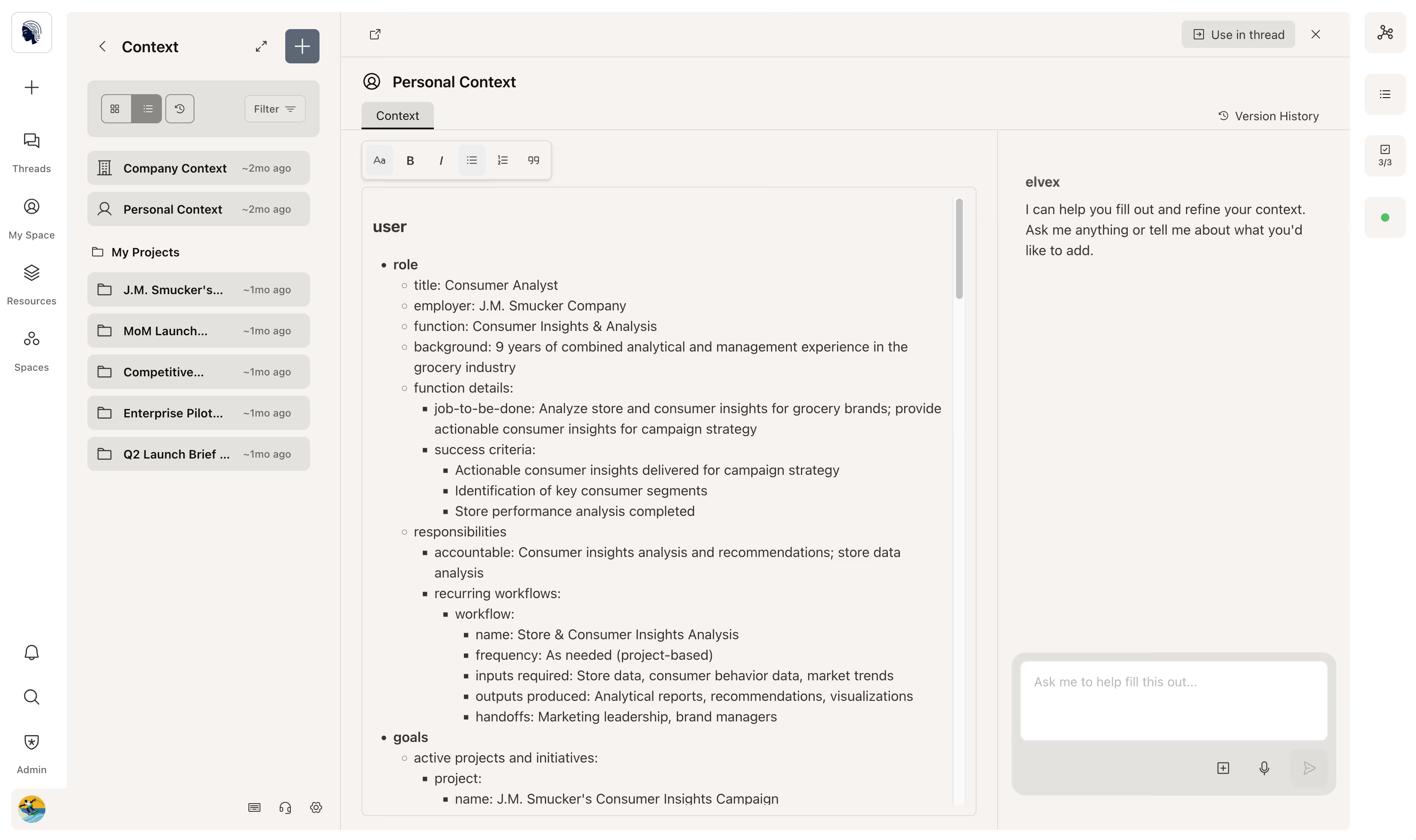
As you work, elvex builds up context about you, your projects and your company, and uses it to point you to better answers and better ways to use AI in your work.
About elvex
elvex is the enterprise agent platform built to close the gap between what AI can do and how approachable it is for the people inside a company.
elvex doesn’t depend on each user to start every interaction. It comes to users with suggestions, drawing on a system that knows your work and what AI can currently do, and connects the two.
By moving from empty chat boxes for individuals to coordination based on company-wide context, elvex lets organizations roll out AI in a way that’s usable, grows with them and fits how work actually gets done. The platform works with any model, any integration and any use case, with enterprise controls including permissions, analytics and cost management.
For more information, visit </>
Media Contact: Alex Gabriel, alex@rally-ai.com