
What Is an Enterprise AI Harness?
You’ve already used an AI harness. It’s the “app” you use to talk to large language models. Every time you use an AI model, you go through some kind of harness. ChatGPT.com, Claude Code/Cowork, Gemini inside Google Search, Glean, elvex, Hermes and OpenClaw are all harnesses, and there are plenty more.
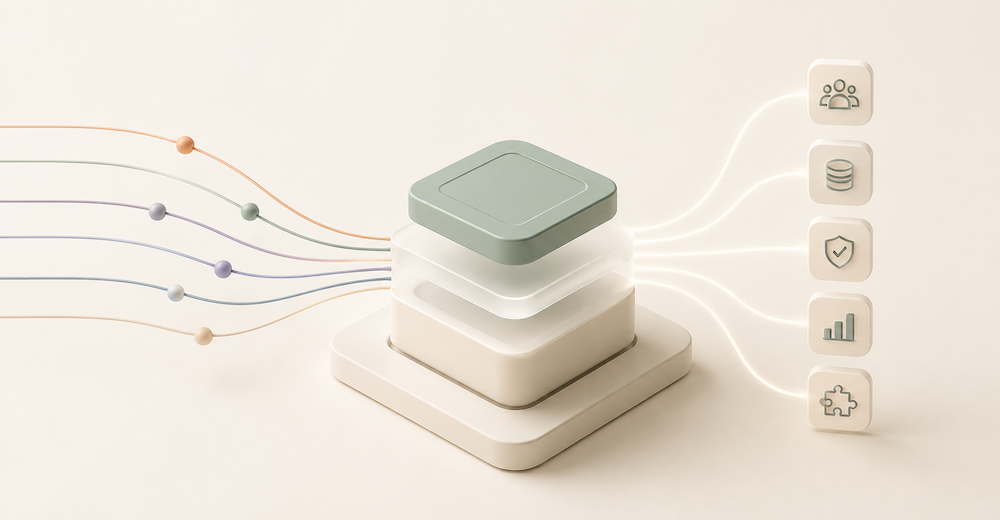
An enterprise AI harness is the software layer between a company and the employees using AI models.
Because it’s built for companies, an enterprise harness differs from the harnesses most people know, which are built for individuals. The differences come down to features that let a company standardize, grow and govern AI use across hundreds (or thousands) of employees who work in teams. They include sharing finished work, sharing agents/“skills” and workflows, data integrations, oversight for permissions and analytics, and data safeguards.
The model is a commodity input, like electricity. The harness is what puts it to work, and it’s where products actually differ.
What a harness is
A harness sits on top of a model and controls how it works. For one person, it has four parts: a system prompt that sets the model’s behavior; tools it can call, such as web search, code execution and email; an agentic loop that lets it check its own work and try again; and a translation layer so the same setup works with whichever model you want to use.
Technical people already take the agent harness for granted. Claude Code made it popular, and open-source harnesses such as OpenClaw, OpenCode, Hermes and Pi turned it into a movement. Your forward-deployed engineers probably use one every day.
Why companies are moving from agent harnesses to enterprise harnesses
Nearly five times more individuals report real AI productivity gains than organizations report company-wide ROI. Gains that stay in one person’s chat history can’t add up to anything bigger for the company.
Our own platform data shows what a better harness does. Across 3.8 million enterprise messages on elvex, the average message got shorter, from 160 to 125 characters (people needed less prompt engineering), as the harness took on more of the work. Over the same period the tasks got harder, rising from 5 to 8.5 model requests per conversation, and satisfaction with the results went from 50% to 80%. The users didn’t change. The harness did. A system that helps one person can help a thousand, and at that point it’s company infrastructure.
What an enterprise AI harness actually does
Six functions define the category, and they double as a checklist for evaluating vendors.
The access layer: where work happens
The access layer is the part employees actually touch. It runs the purpose-built agents for jobs like HR policy questions, sales operations and financial analysis. It includes
- Input & output functionality: chat, with file attachments, writing documents and drafts, data analysis, image generation, voice input, mobile access and Slack.
- Connectivity: integrations and datasources that bring in live data.
The access layer has to be good enough to beat shadow AI. Governance doesn’t do much if the approved tool is worse than the free one. Small UX details decide whether employees adopt it: depth modes for quick or thorough answers, finding and searching agents, bookmarks, searching past conversations. Put simply, it has to be as good, as convenient and as easy to pick up as the ChatGPT app on an employee’s phone.
Model selection and the translation layer
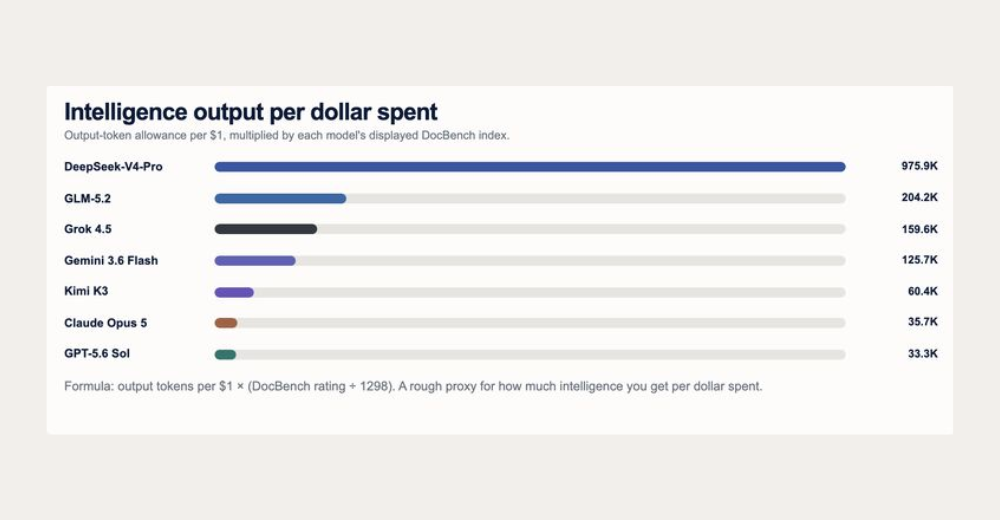
An enterprise harness should work with nearly any model you want, under legal agreements and firewalls that keep your data from leaking or being used for training. OpenAI, Anthropic, Google, or the equally capable options from open-weight providers such as DeepSeek and Kimi that cost 95% less: the point is that your company isn’t tied to one frontier lab’s pricing.
The economics have changed a lot in two years. In early 2024, on the benchmarks that matter for company work, frontier models scored near 86 and open-weight models near 72. By early 2026, open-weight models had reached 95 and frontier models 96, leaving them one point apart. For the drafting, research, summarizing, analysis, classification and question answering people do with AI every day, the only practical difference between closed and open models is the bill, and that difference is large.
Three things make model selection work:
- Normalized prompting: the same prompt works on any model, so a team can switch an agent’s model by changing a setting.
- Per-agent model selection with intelligent defaults: hard problems where cost doesn’t matter go to frontier models, and high-volume routine work goes to open-weight models. This approach can cut AI costs sharply without hurting quality.
- Routing of work to the correct agents: when someone asks for something, the platform should use context and other built-in rules to send it to the agent built for that job (one the user has access to).
It also shortens the gap between a model’s release and your company using it. When a better model comes out, and one always does, you can offer it right away.
Organizational context: the “compounding asset”
Context lets a model understand your company instead of starting from nothing in every conversation. A consumer harness keeps that context in one person’s chat history. An enterprise harness builds it up at three levels:
- Personal context: an employee’s role, preferences, working style and current projects. This is close to the “Memory” you may know from consumer harnesses.
- Team and project context: shared workspaces, called Spaces in elvex, with background information that persists and stays current, pinned agents and datasources.
- Company context: terminology, positioning, policies and institutional knowledge, added wherever it’s relevant.
- Context-based discovery: when someone needs a job done and a public resource in your workspace already does it, the platform should make the connection for them, using what’s in their request, their personal context and the context of the resource. Nobody should have to remember to share it at the right moment.
The harness should pull the relevant pieces of all this context into each conversation automatically, while keeping it editable and governed. There’s a hierarchy: company context outranks personal context, which lets the company give broad direction. Strict controls rarely belong at the context layer, but general guidance does: company branding, terminology, instructions for accessing systems, and similar things every employee needs.
Other people’s work adds another layer between personal and company context. Shared threads, agents and workspaces let one teammate’s breakthrough become someone else’s starting point.
Orchestration: from chat to completed work
Orchestration ties AI conversations to the actual running of the business:
- Agent delegation: agents call other agents, each with its own tools, instructions and data access.
- Scheduled runs: recurring agents run on cron schedules to produce daily pipeline reports, weekly summaries and Monday-morning briefings.
- Integrations as an action layer: agents send emails, update Salesforce records, post to Slack, create Notion pages and call MCP servers.
- Artifacts: reports, decks, spreadsheets and other lasting, permissioned outputs that outlive the conversation.
Chat is the interface. Orchestration is what gets the work done.
Teamwork: agents and workspaces as shared infrastructure
An enterprise harness assumes people work together. Agents, datasources, threads and outputs can become shared, permissioned team assets instead of sitting in one person’s account.
- Agents the team can share: when one person builds a good agent, the whole team can use it, and nobody has to rebuild it for themselves.
- Workspaces for teams and projects: Spaces are environments you can assemble, each with its own context, pinned agents and datasources, and the threads that live there. People and agents work from the same background. A typical example is “the Marketing Team Space” holding the 25 agents the marketing team uses, or the “Q1 QBR Space” with the documents and agents for the team putting the QBR together. Multiple agents, multiple documents and multiple people, with one thing to bookmark and context built in that guides how it all gets used.
- Threads and artifacts with lasting value: a colleague’s conversation, report or analysis becomes a lasting, permissioned asset that outlives the chat it came from.
This fixes the main weakness of what we call Harness 1.0. The first generation of AI tools grew one user at a time, so context and capability depended on each person’s setup and chat history. Sharing is still controlled per resource, with viewer, editor and owner roles.
Governance, spend, and risk control
The permissions that make collaboration possible also make governance possible, and governance is what lets a company roll AI out consistently to everyone:
- Roles and permissions: consumer/member/creator/admin roles, access control per resource, SSO/SAML and user groups.
- Audit logs: full prompt and response history, model provider records, and costs assigned to each user and team.
- Spend visibility and budget control: cost tracking per model and per team, so you see spending before the invoice shows up.
- Security posture: SOC 2 Type II and HIPAA readiness, encryption in transit and at rest, zero-retention database access and temporary code sandboxes.
- Human-in-the-loop approvals: the harness can act, while people sign off on actions that matter.
A security team should be able to ask, “What did the AI do last week?” and get a full answer. The same goes for managers at every level. A manager’s job is to keep people working well, and if AI is involved in nearly all work, the platform has to make it easy to encourage good use without getting Orwellian. Two years ago, at one of our customers, one of the ten most-used agents in the company turned out to be one guy’s personal “help me write a fantasy novel” agent. Good for him, but management needs to know where thousands of dollars in token costs are going. (They stepped in.)
Enterprise harness vs. buying ChatGPT Enterprise or Claude Enterprise
ChatGPT Enterprise and Claude Enterprise are frontier-lab harnesses. They are real harnesses and good products, especially for individual power users. But they’re designed around the needs of the companies that make them.
A lab’s harness exists to sell the lab’s models. Its design leans toward one vendor’s models, roadmap and pricing, because that’s what the business rewards. When the next best model comes from a competitor, a lab harness has no reason, and less and less of a way, to offer it. And when the cost difference is … substantial … the case for an independent harness is hard to argue with.
Who’s already building harnesses (and why most companies don’t)
Uber, Shopify, Cloudflare and Ramp all run their own internal AI harnesses. These custom layers route across models, add company context, and give thousands of employees governed access to AI.
Building one is expensive. Each of those companies needed a dedicated platform-engineering team of hard-to-hire, expensive people. Most companies with 500–5,000 employees can’t justify that headcount for internal tools. And every hour engineers spend building, maintaining and updating a custom AI harness is an hour taken from the company’s actual product. The design is proven. Most companies just don’t have the people to copy it.
Purpose-built enterprise harness platforms get companies what Uber and Shopify built for themselves, without an internal platform team. The results are measurable:
- Embark Consulting reached 72% workforce AI penetration, cut meeting-prep time by 60%, and had non-technical consultants build 500+ AI apps.
- WordPress VIP reached 58% weekly active usage across revenue teams, with 39 agents built by the teams and 100+ people onboarded in two months.
- A national asset management firm cut contract-review time by 80% with a system its own people built, without hiring engineers.
- McClatchy runs 12,000 AI workflows per month across 400+ employees.
- Side-by-side rollouts have produced 3–5x higher adoption than Copilot or ChatGPT Enterprise.
- A 2,000-person MedTech firm cut costs by 50% compared with Copilot.
Companies including The New York Times, Boston Globe and McClatchy run their AI this way.
What to look for in an enterprise AI harness
Ask vendors these eight questions, roughly in this order:
- Does it offer model-agnostic routing, including open-weight models? Being able to choose is the main reason to have a harness.
- Does organizational context compound? Personal, team and company context should persist and get better over time, beyond memory for each user.
- How deep is the governance model? Audit logs, roles, per-resource permissions and SSO/SAML are what security teams will ask for. Look for SOC 2, HIPAA, PII redaction and zero-retention data handling.
- Can you track and control spend for each model and team? You should know what every team and every model costs, so the invoice is under your control.
- Will employees choose the interface over shadow tools? You can’t govern a tool people are using on the side.
- How does it support multiplayer work? Look for shared agents, workspaces and outputs that were designed as team assets from day one.
- What can it orchestrate? Check delegation between agents, scheduled runs, and integrations that take action in your systems.
- What enablement partnership does the vendor offer? Will they actually stick with you, or are they trying to talk to you as little as possible?
Frequently asked questions
What is an enterprise AI harness?
An enterprise AI harness is the software layer between a company and its AI models. It’s the interface employees use. It routes work across models, builds up company context, provides team projects and workspaces, connects to company data, and supplies the governance, analytics and cost controls needed to run AI safely across a whole company.
What’s the difference between an AI harness and an AI platform?
“AI platform” is an older, broader term for anything AI-powered, from model-serving infrastructure to advanced analytics to chat workspaces. “Harness” means the model-independent control layer between a company and large language models, and usually something you can build new workflows with. Every enterprise AI harness is an enterprise AI platform.
What’s the difference between an agent harness and an enterprise AI harness?
An agent harness lets one person use a model through a system prompt, tools, an agentic loop and a translation layer. An enterprise AI harness takes those same single-user ideas across a business and adds shared context, agents and workspaces, governance and audit, spend control, security, reliability, and an interface people who aren’t engineers can use.
Do I need a harness if I’m only using one model provider today?
You don’t really get to choose whether to use a harness, because you can’t use a model without one. Choosing an independent one is the smart move. Prompts, agents, context and employee habits pile up in whichever layer holds them. If that layer is a frontier lab’s app, every use raises what it will cost you to switch later.
Is building an internal AI harness realistic for a mid-market company?
Technically, yes. Economically, rarely. Uber, Shopify, Cloudflare and Ramp built internal AI platforms with dedicated platform-engineering teams. A company with 500–5,000 employees usually can’t justify that headcount for internal tools. Time engineers spend building and maintaining a custom AI harness also comes out of time for the core product. Purpose-built harness platforms deliver the same result without the company building the platform itself.
How does an enterprise harness reduce shadow AI?
By giving employees a better, more useful product. Shadow AI thrives when the approved tool is worse than the free one. A harness gives employees frontier models, company context and useful agents, all inside a governed environment.
How do teams share agents and AI work inside a harness?
Each resource can have viewer, editor and owner roles, so teams can work together while access stays controlled. Teams can also create Spaces, which group several resources: agents, datasources, artifacts, teammates and more. Each Space carries context that tells the people and agents in it how its resources should be used, so an employee can just show up and say “Go.”
How does a harness relate to an AI gateway?
A gateway routes API calls between applications and model providers. It’s infrastructure for engineers. A harness governs the whole relationship between employees and AI: the interface, context, routing, teamwork, governance and spend controls. The two sit next to each other, and some companies run both.
The point of a harness
A company rents its AI models. The harness is how it controls the way employees reach them, the way company context gets to them, and how easily they can be swapped when something better ships. Model quality has converged, and the price gap hasn’t. The companies that get lasting value from AI in 2026 will run a harness that treats every model as a replaceable part.
The best harness is one employees can use without thinking about the infrastructure behind it. If you’re evaluating enterprise harnesses, run your own work through each one and compare the quality of the output and the size of the invoice. See our study on 3.8 million messages, which shows what an enterprise harness changes.