
Build Hard Things. AI Commoditizes The Rest.
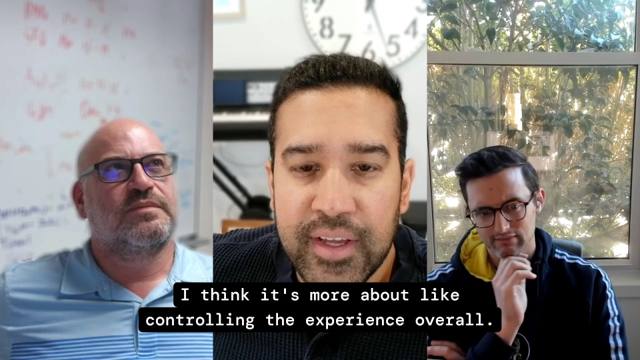
Tal Klein is CMO of Lakeside Software. Its product, SysTrack, runs on every device in an enterprise and measures what the person using that device actually experiences. The market is called digital employee experience, or DEX. Tal has worked at Lakeside twice. He first joined in 2015, seeing a chance to bring Lakeside into the SaaS era (when Salesforce is slow, is it Salesforce’s fault, the laptop’s or the network’s?), and that work led to Insight Partners buying the company in 2019. He went on to Broadcom and came back as CMO in September 2025. He trained as an engineer, has written a sci-fi novel, and moved from San Francisco to Michigan, where the money from an earlier exit, Adallom’s sale to Microsoft, “definitely felt like winning.”
His view is that AI has turned enterprise software as we know it into a commodity. If a product’s value is a UI and a workflow, it “could just be vibe coded today,” and even AI-native startups can be wiped out by a feature you toggle on in your favorite LLM. What you can still defend is work that’s truly hard, such as deep systems internals, and proprietary data with a long history that AI can’t easily recreate. That’s why he went back to Lakeside.
Lakeside is his example. Founder Mike Schumacher wrote it 29 years ago, when compute, memory, disk and bandwidth were all expensive. The agent had to collect telemetry without slowing down the device it was watching (“if the thing that’s collecting user experience is causing user experience deterioration… you’re the problem”). It boils that telemetry down into a structured SQL database on the device. AI does well with structured data because inference is expensive: matching network latency against Microsoft Teams problems is far easier in SQL than in a pile of logs. “If you were trying to vibe code an observability platform today, there’s no way it would build it on top of SQL.” And because it only sends changes to the cloud, personal data stays on the device, so Lakeside meets almost every privacy standard out of the box, German works councils included. Tal admits that part was luck. His advice to builders follows from all this: build hard things. “Challenge yourself to vibe code your idea, and if you’re successful, find another idea.”
The rest of the discussion
- Agent advocacy: when the user is an agent, who calls IT? More and more enterprise “users” are agents and unattended devices, Tal says, like airport bag-tag printers that stay broken because nobody wants two hours on the phone with IT. Agents are finally doing what RPA promised. RPA failed because it tried to squeeze a person’s day into rigid scripts. An agent can copy a workflow faithfully, like opening an app, copying data and sending it to a printer. When something breaks, though, a person files a ticket or complains, and an agent stops, loops or does the wrong thing. Lakeside wants to act as a digital twin that notices the failure and speaks up for the agent or device, or fixes the problem itself. Doyle added that one person might spin up 20 agents without noticing.
- The watermelon effect: green dashboards, red experience. In site reliability engineering, the watermelon effect means the uptime dashboard is green on the outside while users are red on the inside. Datadog, New Relic and similar tools watch the application, but the end user is the one living with the result. Sachin called Lakeside “last mile telemetry.” Tal accepted that but prefers “satellite vs. probe”: the satellite reports a habitable planet while the people on the ground are dying. Even the operating system’s own monitoring can say all is well while an app hangs and someone can’t work.
- Local vs. cloud: where will AI work actually run? Despite all the data center news, Tal noted, Microsoft is building future Copilot versions to use more of the device’s own compute. Sachin said OpenAI and Anthropic are heading the other way, moving work like Claude Cowork’s into their own clouds so jobs can run in parallel, while keeping computer and browser use. Doyle thought the cloud move is about making work multiplayer and keeping skills in sync. Sachin saw that as secondary to controlling the experience, since the labs can’t control how your machine runs. Tal’s answer: wherever the inference happens, a person on a device is still trying to get something done, and you need to see what’s happening there.
- Why Tal built his own AI-visibility tracker instead of buying Profound. His team tracks how often the DEX market comes up when people ask about AI PC adoption, using nine prompts across ChatGPT, Gemini and Claude (Perplexity gets little use in his market). The assistants won’t query each other, so he runs Claude in his browser, signed in as himself, to open ChatGPT and ask as Tal. Building it took a weekend, then five days of tuning, partly to strip out bias. He was careful not to knock Profound. Measuring share of voice isn’t hard and involves no real IP, so he sees Profound as a services company whose value is helping you act on the numbers, such as how to show up on Reddit or which landing pages to add.
- Nobody prompts an LLM cold, so ask customers what they actually typed. By the time someone asks ChatGPT to recommend a DEX platform, it’s probably their 200th day of talking to it, and its answer reflects everything it knows about them. A clean, generic test prompt won’t reproduce that. Lakeside asks customers instead. When a customer sent a competitive renewal RFP that was obviously part LLM-written, Lakeside asked for the prompts behind it, and Tal says no one has said no yet. They do the same when a customer suddenly asks for a feature, tracing it back to what they asked an LLM. You still miss the full context, but you get prompts in your ICP’s own words instead of a marketer’s guesses.
- For enterprise buyers, analysts and reviews still drive the decision. Lakeside sells to large enterprises and has to go on every device, so a single team can’t just try it. Its buyers trust Gartner, Gartner Peer Insights and G2, so Lakeside puts extra weight on analyst relations with Gartner, Forrester, IDC and ISG, on purpose. A company selling to smaller businesses, whose customers probably don’t pay for Gartner, would spend elsewhere. Find out where your ICP actually looks.
- Markdown files written only for AI crawlers are “keyword stuffing for the modern age.” Tal thinks they work for now, and Lakeside probably does a bit of it, but he expects AI companies to stop paying attention, the way Google eventually penalized keyword stuffing. Telling an LLM what your site covers is fine if the content is really there. Further out, he expects websites to get an MCP front end (he pointed to Microsoft and WebMCP) that takes an agent’s question and answers it directly, saving the agent the inference cost.