
Where Are You Building the Capability to Look Forward?
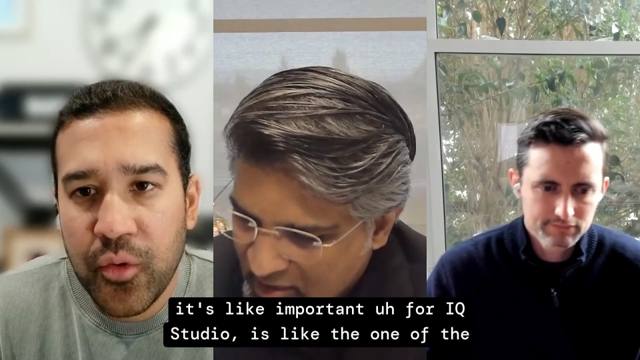
A conversation with Simon Ninan, Chief Strategy Officer at Hitachi Vantara
Simon Ninan has a job few people in enterprise AI have: he thinks about infrastructure for the physical world.
He is Chief Strategy Officer at Hitachi Vantara, the IT and data management arm of Hitachi, Ltd., headquartered in Silicon Valley. That puts him where two fields meet that have long been kept apart: IT (information technology) and OT (operational technology). The trains, power grids, factories and smart buildings Hitachi builds are OT. The data storage, AI infrastructure and software platform Hitachi Vantara builds are IT. Simon’s job is to connect the two in ways that pay off.
The Question Every AI Leader Needs to Answer
Large language models are trained on the accumulated body of human knowledge. That’s where their power comes from. They can synthesize, find patterns and generate across a huge range of subjects faster and at a larger volume than any human team.
But the way they’re built means LLMs always look backward. Simon said so plainly:
“You can train it on the entire body of human knowledge up to this point,” he said. “And you can keep training it. But it is perpetually backward looking. For our world to evolve, where are you building the capabilities to look forward?”
The Edge Is Your People
Most enterprise AI talk right now is about productivity: what can be automated, sped up and measured against a 12-month ROI target. Simon thinks that view is incomplete, and he kept coming back to one idea underneath it: the moat in AI is domain knowledge, and the model itself isn’t where it lives.
Hitachi’s own position shows why. Simon called the company’s “secret sauce” its domain knowledge, meaning it understands how things work on the ground: “every process, every broken rivet and the impact that it can have, every operational impact on the downstream.” AI companies that come purely from IT can build great platforms, but they don’t know what a train sensor means when it fires, or what a power grid anomaly looks like physically. That knowledge takes decades to build up and can’t be trained into a model.
The same goes for any organization rolling out AI. Institutional expertise, an understanding of how the processes really run, and judgment formed over years in one field are things AI can’t copy from training data. Companies that give those up for short-term AI efficiency will pay for it.
How to Avoid Being A Bad Leader
Simon didn’t soften his challenge to leaders: “If you are a leader in an organization and you are trying to solve, ‘I need AI productivity in the next 12 months,’ but you’re not thinking about what the shape of your organization looks like five years and ten years from now in the context of all of this evolution, I’m sorry, you’re doing a bad job as a leader.”
Sachin pushed back. Most executives are anxious because things move so fast they can’t see 12 months out, never mind 10 years. Simon answered that the job isn’t to predict the technology. It’s to protect the core. “What’s the core value of the company? If I believe that there’s an essence of my core value that’s going to stay intact or going to evolve around that perimeter five, ten, fifteen years from now, how do I protect that core value and build the right knowledge systems, technology systems, and other systems around it?”
Hitachi plans in 50-to-70-year cycles. A dedicated think tank studies mega-trends (climate change, social-political unrest, demographic divides, resource constraints) and works backward to decide what to build now. The company is 115 years old and still shows up regularly on lists of the world’s most innovative companies.
Leaders who race to deploy AI and forget about creativity, new ideas and the next generation coming up through their companies will eventually hit problems a new model release can’t fix.
What Hitachi Is Building: iQ and iQ Studio
Simon’s long-term thinking is backed by something concrete: a product stack Hitachi Vantara has been building and refining for years.
The Problem: Accelerating AI ROI for Enterprise Buyers Under Pressure
The core problem in the market, as Simon put it, is “the delivery of AI ROI and faster time to ROI.”
He described how that pressure is changing the enterprise buyer. IT purchasing used to be an IT decision. The business threw requirements over the wall, IT negotiated the best price, and everyone took what they got. That’s over. Line-of-business leaders now sit in the room asking about ROI, and more and more AI spend is charged to their budgets instead of IT’s. That changes the financials, the commercial model and the kind of conversation vendors have with customers.
More than 50% of Hitachi Vantara’s customers are large banks, healthcare companies and governments. They push ahead in some areas and are very cautious in others. With customers like that, a deployment means long POC phases that check governance, security, compliance and accountability before anything reaches production. The tools have to be sovereign, governed and usable by line-of-business operators.
The Solution: Vertically Integrated Stack, with Domain Expertise Built-In
Hitachi iQ is Hitachi Vantara’s converged AI infrastructure stack, built on NVIDIA GPUs. It combines compute, storage for structured and unstructured data, and a platform that manages across them at high performance. It scales from small deployments to very large ones through what Simon calls “t-shirt sizing” to fit each customer.
Hitachi iQ Studio is the software layer on top. It launched in a first version and then got a major release with big updates. It’s a low-code, no-code agent builder with pre-built blueprints, automations, integrations and MCP support built in.
What sets it apart is what comes preloaded. Long before LLMs, Hitachi’s R&D teams were building and refining specialized algorithms for industrial uses like trucking, fleet management and predictive maintenance. Those algorithms now ship inside iQ Studio as ready-made blueprints. A line-of-business operator can stand up a governed, sovereign AI agent from industry-specific building blocks proven by decades of operational work, without writing code or leaving their own infrastructure.
Simon described it as “an essential glue layer to work between the underlying infrastructure and the overlying applications.” It connects the AI data foundation to the real workflows that run on top of it.
The Approach: Heterogeneous by Design
The platform is built to work with many systems. MCP is built in for model-agnostic orchestration wherever the data sits, and the approach to data is hybrid by default. Simon described a view the company has held for years: enterprise data will never live entirely in the public cloud or entirely on-premise. It will always span several environments, and companies need to orchestrate across them and get “the right data from the right place at the right time.”
His go-to-market line was just as clear: “Our architecture will allow you to use this even if you don’t use our product in the background. But if you use our product, all the better for you.” elvex believes the same thing about not locking enterprises into one vendor’s roadmap.
Changing Personas and AI Risk Profiles
The BizTech Buyer Is the New Enterprise Persona
Simon has seen the enterprise buyer change a lot in recent customer conversations. IT used to own the purchase, and the process was complex, technical and mostly opaque to the business. Now line-of-business leaders are in the room asking about ROI, and AI spend lands on business-unit budgets.
Simon calls this person the “BizTech buyer” and says it’s “the new persona that we have to try to sell to.” It’s a hybrid role that spans technology and business, and more and more it’s the person who makes AI decisions and has to justify their value to stakeholders across the company.
He has seen the strain among his own customers: traditional storage people who know the world is changing around them and now have to think beyond their old role. “The world is being eaten from both sides,” he said. The tools, conversations and onboarding the old enterprise buyer needed don’t fit this one well.
70% of CIOs Said They’d Shut Down Agent Access Entirely
When autonomous agents came up with a room of CIOs and CFOs, Simon ran a live poll. Would they let employees use agents and patch security risks along the way, or shut access down completely? Seventy percent said they’d shut it down.
When employees build their own agents and download third-party skills, they often connect to outside repositories they don’t fully understand. Simon cited data showing that 60% of individually built apps in enterprise environments have day-zero vulnerabilities, and every dependency an agent pulls in widens the attack surface.
His position is that a human in the loop is a required part of the design. “Where is your point of someone looking at it, someone validating it, but also someone taking accountability for it?” Hitachi itself is still working out the accountability question internally. Simon compared it to military drones: systems in the middle that put distance between an action and the person accountable for it. “Trust is very, very difficult to build, but very easy to break. It’s fragile.”
He also agreed with a point Sachin raised: enterprises that refuse agents altogether will fall behind startups willing to take the risk and move faster. Governance is how you move forward.
About Simon Ninan
Simon Ninan is Chief Strategy Officer at Hitachi Vantara, where he leads AI and hybrid cloud strategy. He also sits on the Corporate Strategy Office of Hitachi, Ltd., advising on how Hitachi’s businesses in North America can work together.
- LinkedIn: linkedin.com/in/simonninan
- Hitachi Vantara: hitachivantara.com